
Bismillah al-Rahman al-Rahim
The Living from the Dead
Sura 10, Verse 31
Added November 09, 2005
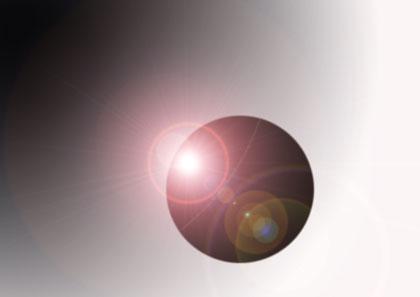
“And Who brings forth the living from the dead, and brings forth the dead from the living?” (Qur'an 10:31)
The clay, (the earth or raw material through which we are created) is a dead thing (but has the capacity to come to life). The spirit is a living thing - the source of life. In the symbolic language of the Qur'an, we are composed out of these two opposites – clay (or earth) and spirit - one low, the other high, one dead, the other alive. They are combined in us so that we contain within ourselves both the properties of life and death, of spirit and matter. These two opposites intermingle and co-exist within us. Within us, life and death are neighbors even if they are opposites. Our death is woven into our physical nature, held at bay by the life which suffuses our bodies for a time.
In sura 36 verse 37 the Qur'an says: “And a sign for them is the night: We pull out from it the daytime, and they are in darkness.” Light reaches everywhere and only when it is withdrawn or occluded or eclipsed does darkness become evident. Likewise, when “life” (light) is withdrawn (pulled out) from a living thing, that thing returns to the darkness of dead clay, dead matter.
God is the author of life and death – He creates things with the capacity to receive life under certain circumstances, and sets up the systems by which physical matter organizes into complex forms and comes alive. Within these systems He also sets up the conditions and parameters (health, nourishment etc.) within which life continues, and the limits (old age, disease, injury etc.) beyond which it will be withdrawn, revealing the death eclipsed and concealed within the living. When light is present and nothing occludes the light, the night is held back - when light is blocked or withdrawn the night becomes evident. When life is present in a body (when the appropriate conditions and parameters are present), the inertness of dead matter is held back and matter is suffused with life – when life is withdrawn (when the conditions and parameters for life are no longer present or are damaged), the inertness of dead matter becomes evident and begins to manifest itself.
The Qur’an also refers to belief as life and light, and disbelief as death and darkness. In 6:122 it says: “Is He who was dead then We raised him to life and made for him a light by which he walks among the people, like him whose likeness is that of one in utter darkness whence he cannot come forth.” It also speaks of those whose hearts are alive and those whose hearts are dead. “Dead are they, not living….” (Qur'an 16:21) So just as God brings forth the dead from the living and the living from the dead, He brings forth an unbeliever from a believer and a believer from an unbeliever – a spiritually alive person from a spiritually dead person. “Learning is like light to an empty, listless form” – acquiring correct knowledge and wisdom is like a lifeless form coming to life – and ignorance, spiritual rebellion, and rejection is like the onset of spiritual death.
A person's nafs (soul) becomes the battlefield of light and darkness – the struggle within the nafs is the place where light and shadow, belief and unbelief, knowledge and ignorance, spiritual life and spiritual death, struggle against one another. If a person moves in the direction of rejection and rebellion, blinding themselves to guidance and to realities beyond the immediate, they are engaged in creating the conditions and parameters within their own selves that lead to a spiritual death - a slow withdrawing of light and the onset of an internal darkness. God makes His illumination available (to whom He pleases from among those who sincerely and knowledgeably seek it) as a life-giving sustenance capable of banishing all forms of darkness and bestowing depth and substantiality to life - “Light upon light – Allah guides to His Light whom He pleases.” (Qur'an 24:35).
Just as He provides our bodies sustenance through the earth and what it produces, He provides our spirits sustenance from the heavens - from levels of reality deeper (more elevated and comprehensive) than this world. “Say: Who gives you sustenance from the heavens and the earth?” (Qur'an 10:31) The spiritual sustenance is embodied in the forms of the Prophets, the Qur'an, and the many and varied forms of inspiration and guidance that God provides and which intersect with our intellects and hearts providing them with a substantiality which they otherwise lack.
Bringing forth the living from the dead then encompasses several possible meanings - coming spiritually alive after being spiritually dead, coming to life through knowledge and leaving behind the state of ignorance, the ressurrection after death, dead matter coming to a state of complexity by which it attains the capacity to manifest life, and the miracles by which the Prophets raised the dead to life or gave life to inanimate matter (as when Jesus (a.s.) brought Lazarus to life or gave life to the form of a bird).
Another possible meaning is a reference to the innate potentials given to inanimate matter and to the complex systems which govern its behavior. Matter has been created infused with potentials which allow it to combine and recombine into a bewildering variety of complex forms. Complex forms unite with each other into endlessly intricate structures, certain of which can give rise to life. God has placed concealed potentials within the nature and systems of the material world - these potentials emerge only with the arising of certain material architectures - these architectures arise through the action of deeply embedded structural logic which manifests through interconnected reiterative processes that produce vastly complex superstructures. These forms emerge through a bootstrap process by which layers of complexity build upon one another. On the one hand, the complexity emerges from inherent internal patterns within matter, on the other hand, matter is lifted into complexity by the endlessly varied mutual interworking, interaction, and exchange that occurs within and between complex forms. On the one hand, it is as if an inexorable and unfathomable Divine process pushes forms upwards to complexity, on the other hand, it is as if Divine attractors pull forms through succesive shapes and levels of complexity until they arrive at a level of interworking and balance capable of giving rise to life.
“Our Lord is He Who gave to everything its creation, then guided it to its goal.” (Qur'an 20:50)
The entire system and it's inbuilt logic, intellegence, potential, and complexity is authored and sustained and guided by God and supported by invisible layers of existence which interpenetrate and encompass the workings of this material realm, lending it a deep and profound logic, aspect, and potential. Dead matter - through appropriate interactions, through the arising of an intricately balanced complexity - can arrive at a pattern and state known as life, fulfilling the potentials concealed within it. God is the author and sustainer of the system and of all the invisible realities which encompass it and drive it - so it is said that God alone is the true author of life who brings life to dead matter and who:
“brings forth the living from (that which on it's own is) dead.“ (Qur'an 10:31)[1]
*
To be notified when new articles are added to this site, please follow @i_from_i (islam from inside). Or, if you prefer, subscribe to the islam from inside RSS feed.
Footnotes
-
Related Articles