
Bismillah al-Rahman al-Rahim
Dreams in Sura Yusuf
Sura 12, Verses 36 - 37
Added December 28, 2008
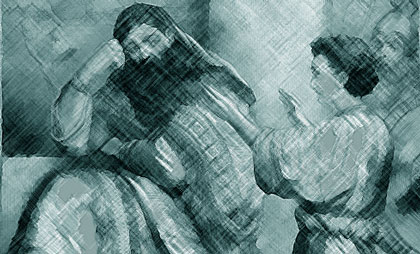
“And two youths entered the prison with him. One of them said: I saw myself pressing wine. And the other said: I saw myself carrying bread on my head, of which birds ate. Inform us of its interpretation (tawil); surely we see you to be of the doers of good (muhsineen).” (Qur'an 13:16)
“He said: There shall not come to you the food with which you are fed, but I will inform you both of its (the dreams) interpretation (tawil) before it (the food) comes to you; this is of what my Lord has taught me; surely I have forsaken the religion of a people who do not believe in God, and they are deniers of the hereafter....” (Qur'an 12:36-37)
Joseph (Yusuf) is seen as one of the muhsineen, one of those whose actions exhibit the quality of ihsan, of beauty and goodness - one whose actions are beautiful. This is a kind of spiritual beauty that arises through an elevated inner state, and is reflective of a personality whose architecture derives its qualities from a higher reality. So Joseph's companions in the prison turn to him and say, concerning their dreams: “Tell us of the tawil (the hermeneutical interpretation) for we see you as one of the muhsineen.” (Qur'an 12:36) They see him, through the spiritual beauty of his conduct and manner of expression, as one who has a knowledge beyond ordinary knowledge. And Joseph himself indicates that he knows the tawil through what God has taught him (“...this is of what my Lord has taught me; surely I have forsaken the way of a people who do not believe in God....” (Qur'an 12:37)), and this is an indication of his status as a messenger.
The prisoners ask for an explanation of their dreams since, although they were powerfully affected by them, they cannot comprehend them. Dreams embody what is not physical - they take fears, feelings, anxieties, thoughts, ideas, and concepts and display them in the garb of symbolic forms and events - they give a body, a form to the contents of our mind. So what is seen in a dream is not meant to be taken literally. In fact, it cannot be understood in a literal manner without seeming absurd or confused. Because of the symbolic nature of dreams, they require interpretation to be understood. Without interpretation they only confuse us.
Dreams can be a psychic play whose characters and plot are based upon the inner movements of our mental world and as such they can display the state of our souls (our selves (nafs)) to our own selves. They can be a way of processing the meaning of events that occur in our lives and so incidents from our lives and the perturbations and turmoil (the good and the bad) of our inner states can manifest in symbolic form in our dreams. As well, time and space, as they manifest in dream landscapes, become subordinate to the symbolic content of a dream so it is possible that a person may seem to live through long periods of time and travel vast distances in the span of one brief dream.
Dreams can also be visionary because our nafs is hooked into deep levels of reality and sometimes we can witness (through symbolic forms) these deeper aspects of reality and our entanglement with them. Such dreams are bursting with meaning - conveying a symbolic, compressed truth that comes to us through our subconscious but which we cannot usually grasp while in a conscious state. The dream displays its message in a symbolic language received without our volition like an inspiration or message which perplexes us. With such dreams we know we have received a message through our souls connection to other levels but we have not the means or knowledge to interpret, to translate these messages.
Something deep has occurred, some truth, some revelation about reality or about our own inner state has been conveyed in the dream - our minds have come into contact with a layer of reality which has left its impression on our souls - but the language of the dream is a cloaked symbolic language. So we shake our heads and say “confused dreams”, “jumbled dreams” (Qur'an 12:44) unless the dream is presented to someone like Joseph, who has the ability to do tawil.
The prisoner's dreams required interpretation since the dreams occurred when they were sleeping and so the correspondence, the parallels, the links had to be made between what they witnessed while asleep and what occurs in the waking world. In other words, their vision in sleep must be interpreted in terms of this world - in the context of this reality - to understand what it symbolizes and what portent, if any, it points to in this world. The dreams of the prisoners were, perhaps, dreams that contained a mix of elements - they were signs of the states of their souls but they also conveyed a hidden knowledge which their souls acquired in the state of sleep. There are several possible aspects to this.
One aspect is that their dreams were a means for their souls to process their guilt or their innocence (they knew whether they were guilty or innocent of what they were charged with) - they were cognizant of their own guilt or innocence and this perhaps manifested in the nature of their dreams.
Secondly, they were granted a symbolic visionary image of the future that awaited them. In the state of sleep their nafs were shown signs of their future destiny. Their nafs came into contact with a deeper level of reality, one in which time is spread out differently than it is in this world, so they were able to gain a knowledge of how their life was to unfold in the near future. They were able to glimpse the future that was written for them. They knew they had witnessed a dream of a special nature, one imbued with power and significance, one that affected them in a deep and forceful manner. So they felt an urgency in seeking out someone who could interpret it for them. Likewise for the King of Egypt who witnessed a dream (of the seven healthy and seven lean cows), a vision that had such an intense impact upon him that he dismissed out of hand the opinion of his advisors that these were just “jumbled dreams”. “And the king said: Surely I see seven fat kine which seven lean ones devoured; and seven green ears and (seven) others dry: O chiefs! explain to me my dream, if you can interpret the dream. They said: Confused dreams....” (Qur'an 12:43-44) The strength of his vision led him to determinedly seek someone who could interpret it for him and to persist in this seeking until he learnt of Joseph.
Note: Interestingly, the prisoners dream only about their own fate while the King dreams about the fate of all Egypt. The King, by virtue of being one whose consciousness of his office and responsibilities and obligations extends out to the boundaries of the lands he rules over, expands the arena of his consciousness to encompass his entire kingdom. The boundaries of his mental self are far wider than that of the prisoners whose boundaries are shrunken since their autonomy is limited by their position within the kingdom and, perhaps, by their own natures.Since the language of dreams is a cloaked, symbolic language - a language of ideas, concepts, and truths embodied into various forms, into bodies and events that symbolize the true meaning - because of this it remains opaque to most. They do not know how to interpret so they shake their heads and say “confused dreams” (Qur'an 12:44) as the King's courtiers did. But to one, like Joseph, who has a substantial and continuous connection with deeper levels of reality, the language is clear and evident since it is an analogue of the symbolic language of revelation and of the higher reality from which revelation descends and then embodies itself in various ways in our world.
Note: “Confused dreams” is also used in the Qur'an to describe the state of those who reject any notion of higher realities and so claim that the verses of the Qur'an were the result of nothing more than confused dreams. “Nay! say they: a confused medly of dreams; nay! he has forged it; nay! he is a poet....” (Qur'an 21:5). They are unable to recognize the symbolic language of revelation and so to them it is like a dream which they cannot comprehend and so dismiss. They do not realize that it is a pointer to a greater reality which cannot be simply stuffed into the common words and phrases of this world.When the Prophet Muhammad woke after sleep and sat with his companions, he would sometimes ask them, “have any of you had a dream/vision” and then he would interpret it for them. He considered dreams a form of self-knowledge and sometimes a form of minor inspiration. In the first case the dream indicated the state of the dreamer's soul and gave clues as to what needed correction in that person's life. In the second case the dream was a form of useful and truthful knowledge that arrived through the companion's dream but in a form that the dreamer did not understand. The dreamer described the form to the Prophet and the Prophet translated it into its meaning.
Now, just as dreams require interpretation since all that happens in a dream is clothed in symbolic forms, so also do events and occurrences in this world require interpretation (in relation to deeper, more real levels of reality). According to the Prophet “people are asleep, and when they die they awaken.” So in this world we are as if asleep and dreaming a detailed, marvelous, completely engaging dream. When we wake in the next world we will become aware that this present life is like a dream just as in this life when we sleep we enjoy ourselves or suffer in a dream as if it is entirely real until we wake and realize it was only a dream.
Since, according to the Prophet, people are asleep in this world, the events of this life are like dreams and must also be interpreted (must be subject to a process of tawil) in terms of the next world which is the world of wakefulness in comparison to this world. As the Qur'an states: in that domain (the hereafter) their “vision is piercing, awake.” (Qur'an 50:22).
A small hint of this is apparent in the story of Khidr (Qur'an 18:60-82), which shows that due to the limitations of our knowledge, we readily and zealously misinterpret the true nature of events in this world. Khidr is a mysterious figure who was, for a time, a teacher to Moses. He carried out actions that, in Moses view, seemed destructive and harmful and so Moses protested against what Khidr did. Then Khidr explained the true nature of his actions and the benefit concealed within all that he did. In each case, the apparent harm concealed a great benefit. All of Khidr's actions seemed absurd and senseless until the interpretation revealed their true nature. Khidr was demonstrating to Moses, the limits of knowledge and the pitfalls of limted perspectives. A step along the path of what Khidr demonstrated is the interpretation and meaning of the events and forms of this world as it relates to the perspective of the next world (of higher realities).
People live their lives, and what they do and how they live are a series of symbols, of encoded meanings which map onto higher, truer levels of reality - the reality to which we are all eventually (after death) fated to awaken. The prisoners and the King dreamed and knew that their dreams mapped somehow to the waking world. Prophet Joseph provided the explanation of this mapping for them. Our lives in this world are like a waking dream and the Qur'an and revelation, having come down from a higher reality, provide a map, a decoding guide to this higher reality so that the signs that are continually on display on the horizons (of this world, this life) and within our own souls may be recognized as wellsprings of guidance to felicity in this world and the next.[1]
*
To be notified when new articles are added to this site, please follow @i_from_i (islam from inside). Or, if you prefer, subscribe to the islam from inside RSS feed.
Footnotes
-
Sleep Until Death
1 – Since the Prophet said that “people sleep and when they die they awaken” this means that the waking state is like a sleep in which people are unaware of the tremendous spiritual understructure which undergirds this world. So when spiritual realities are perceived in Joseph's revelatory dream, that dream is more real than the events it foreshadows in the sense that it gives a truer picture of the nature underlying the events in this world.
Joseph's sleep was therefore more truthful than the events in this world. So when Joseph says "this is the meaning of my dream" he might have said “this is the manifestation of the spiritual realities I beheld in my dream.” The events in this world then are treated like a dream - so when Joseph perhaps grows anxious or frustrated or undergoes hardship, it is like the anxiety or frustration we may feel in a dream - we get lost in the dream and it feels real to us - but when someone shakes us and we partially wake enough to realize we are dreaming we are reassured and can sleep peacefully again. When Joseph is lowered into the well by his brothers and grows anxious, Allah reassures him through inspiration, like someone nudging you during a bad dream, so you realize the true state of affairs and grow calm once again.
Over time Joseph increases in his ability to interpret the realities behind events (as well as the true meaning of dreams) so his life becomes anchored and calmed by spiritual realities. He is like a dreamer who dreams while he is awake. No matter how bad the dream he knows the deeper reality underlying the situation - he knows this takes precedence over the shifting and fleeting realities he faces so he does not fear or despair but undertakes the most appropriate actions in response to each situation. Everything he does arises from a continuous process of tawil. His dreams apprise him of the spiritual reality underlying events in this world, and the events in this world are in turn dream symbols in comparison to higher realities.
Related Articles
– (Sura 12: verse 99 - 101) - The Fulfillment of Yusuf's Dream - the Sun, the Moon, and Eleven Stars